Hi, my name is Jim Macdonald, and I have an odd assortment of interests. In no particular order, I love Yellowstone, I am an anti-authoritarian activist and organizer, and I have a background in philosophy, having taught at the college level. My blog has a lot more links to my writing and my other Web sites. In Jim's Eclectic World, I try to give a holistic view of my many interests. Often, all three passions show themselves interweaving in the very same blog. Anyhow, I think it's a little different. But, that's me. I'm not so much out there, but taken together, I'm a little unusual.
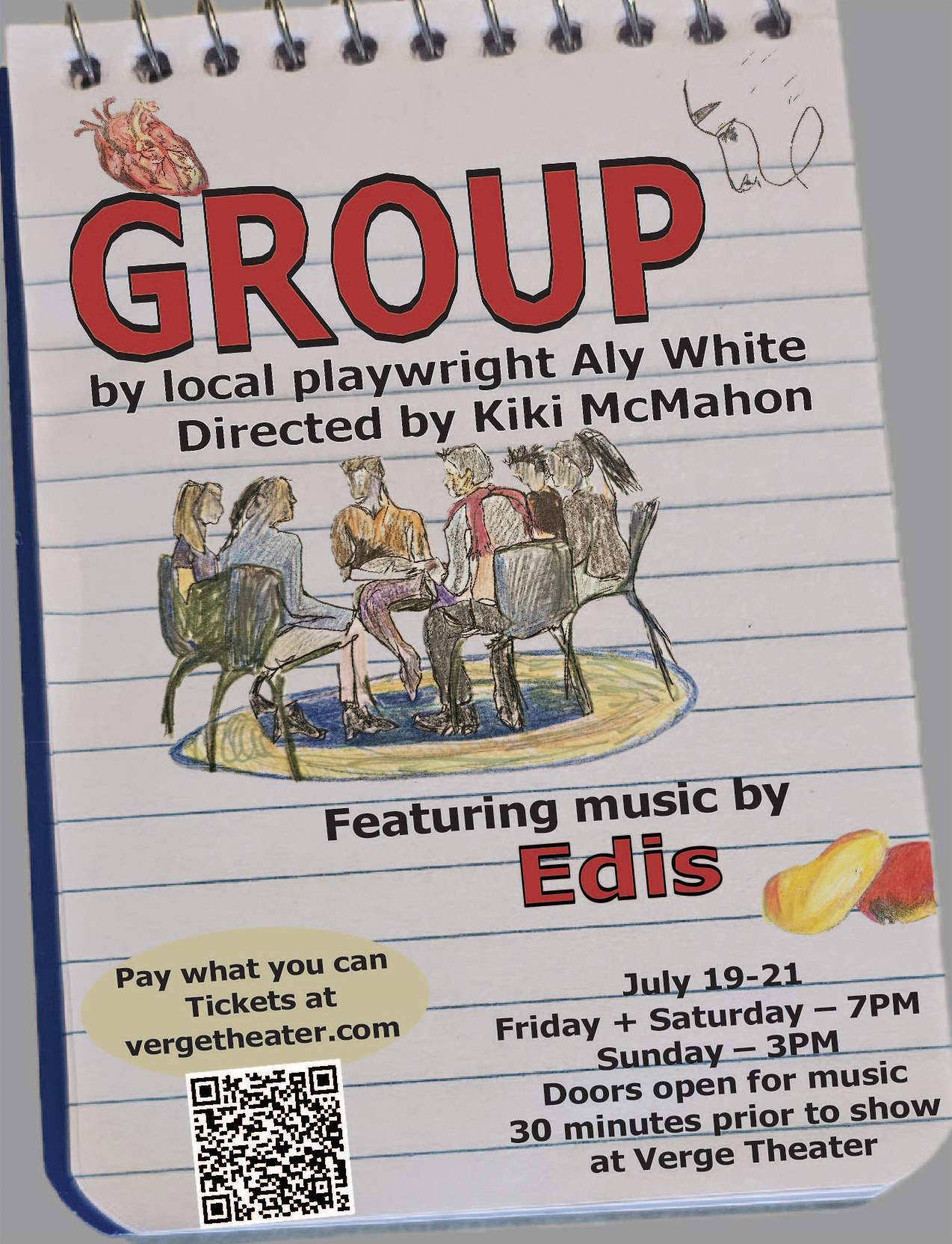
I'm in a play! It’s called “Group,” and it’s showing at the Verge Theater in Bozeman on July 19-21. It’s a sweet and beautiful one. It’s written by my best friend Aly White and directed by our dear friend Kiki, and I am in it, too (actively involved producing and editing it). We have a delightful cast. The play is about (mostly) strangers coming together and taking emotional risks. It’s been amazing putting together a real play in partnership with Verge Theater, doing a project close to our hearts. Aly wrote this play to me originally as a Christmas present.
Published today, my Chakradance student Christine Renee interviews me about Chakradance. The discussion becomes a wide-ranging discussion about my journey in Chakradance and about the process of facilitating and holding safe space. For more about my Chakradance facilitation, go to https://dance.intimacycadre.org.
My best friend wrote this play, I edited it, and another close friend is directing it. We are all performing in it. We are seeking others to join us.
CASTING CALL
We are creatives seeking open individuals to connect with through art and vulnerability. Currently casting three roles in an original work written by Aly White, and edited by me.
Our story revolves around an ad – not unlike this one – and the six artists who respond to it. What they share and discover over the course of two group sessions sets in motion a profound transformation.
Please note this piece discusses sexuality, grief and mental illness including suicidality.
We are looking to cast:
Rita: Female presenting, 30s-50s, a queer filmmaker who organizes the group.
Sidney: Any gender, 20s-40s, Rita’s nonbinary friend in the industry with a passion for social justice.
Polly: Female presenting, 50s-70s, a lonely eccentric with a storied past.
Auditions will be held at 3pm on April 6th and 6pm on April 9th. Sign up here. If you have any further inquiries about the project, you can email Jim at jsmacdonaldjr@gmail.com.
Check out my revamped Chakradance website at https://dance.intimacycadre.org for details and to register. I am very happy to be offering this in Bozeman again. Classes start February 17, 2024 and run for nine weeks. It is a pay what you can model (suggested $200 for the course). Some drop ins may be available. Full details on the site :).
This is the podcast to watch and dance to (not simply to listen to). Aly and I (Jim) show an hour of us dancing in public so you can see what it looks and feels like. Between sets, we talk about dancing, how you can dance with us, and just what goes on in the Bozeman streets. We are dancing Wednesday, January 10, 2024 at Soroptomist Park (at Main and Rouse) in Bozeman from 5-6 PM (and probably again on January 17 same time and place). If you are watching this after those dates and want to dance, contact us at https://www.bozemanantifadance.org or by email at bozemanantifa@gmail.com.
We had so much fun dancing (and had a dancer join us briefly). Please consider getting out of your chair and dancing along with us!
We’d love for you to check out the musical artists that make up the playlist we were dancing to. For the entire playlist in order (and a half dozen bonus tunes), check out our podcast playlist on Spotify. Unfortunately, because of some copyright claims that some of the artists put on some of our songs, five of the songs had to be cut down significantly and muted, but you still get about 45 minutes of us dancing. The tunes that appear in this podcast in order (artist – song):
Set 1
1. Girl and Girl – “Dance Now” (trimmed down to about 15 seconds and muted)
2. Ella Andall – “Rhythm of a People”
3. Car Seat Headrest – “Fill in the Blank” (trimmed down to about 15 seconds and muted)
Set 2
4. Madison Cunningham – “Hospital (One Man Down)” (Featuring Remi Wolf) (trimmed down to about 15 seconds and muted)
5. Talking Heads – “Blind” (trimmed down to about 15 seconds and muted)
6. deep tan – “diamond horsetail”
7. Delores Forever – “Why Are You Not Scared Yet?”
8. Melody Angel – “Blues In My Hands”
Set 3
9. Too Many Zooz – “Funky Christmas” (Featuring Big Freedia)
10. The National – “The System Only Dreams in Total Darkness” (trimmed down to about 15 seconds and mutued)
11. David Byrne – “Help Me Somebody”
12. Propaganda – “Gentrify”
13. Dj Farrapo – “Marcianito” (Cristina Renzetti Vocal Version)
Set 4
14. Shungudzo – “It’s a good day (to fight the system)”
15. Sir Woman – “Party City”
16. Bully – “Every Tradition”
Finally, we do have an audio-only version of the podcast, though for once, we don’t recommend it since the entire point of this podcast is to see and or get a fuller experience of what street dancing looks like. Even if for some reason, you are vision impaired, only the video-only version contains full music that you can dance along with. However, if you really just want to hear us talk for 35 minutes, here you go – we do have very short musical interludes in this version.
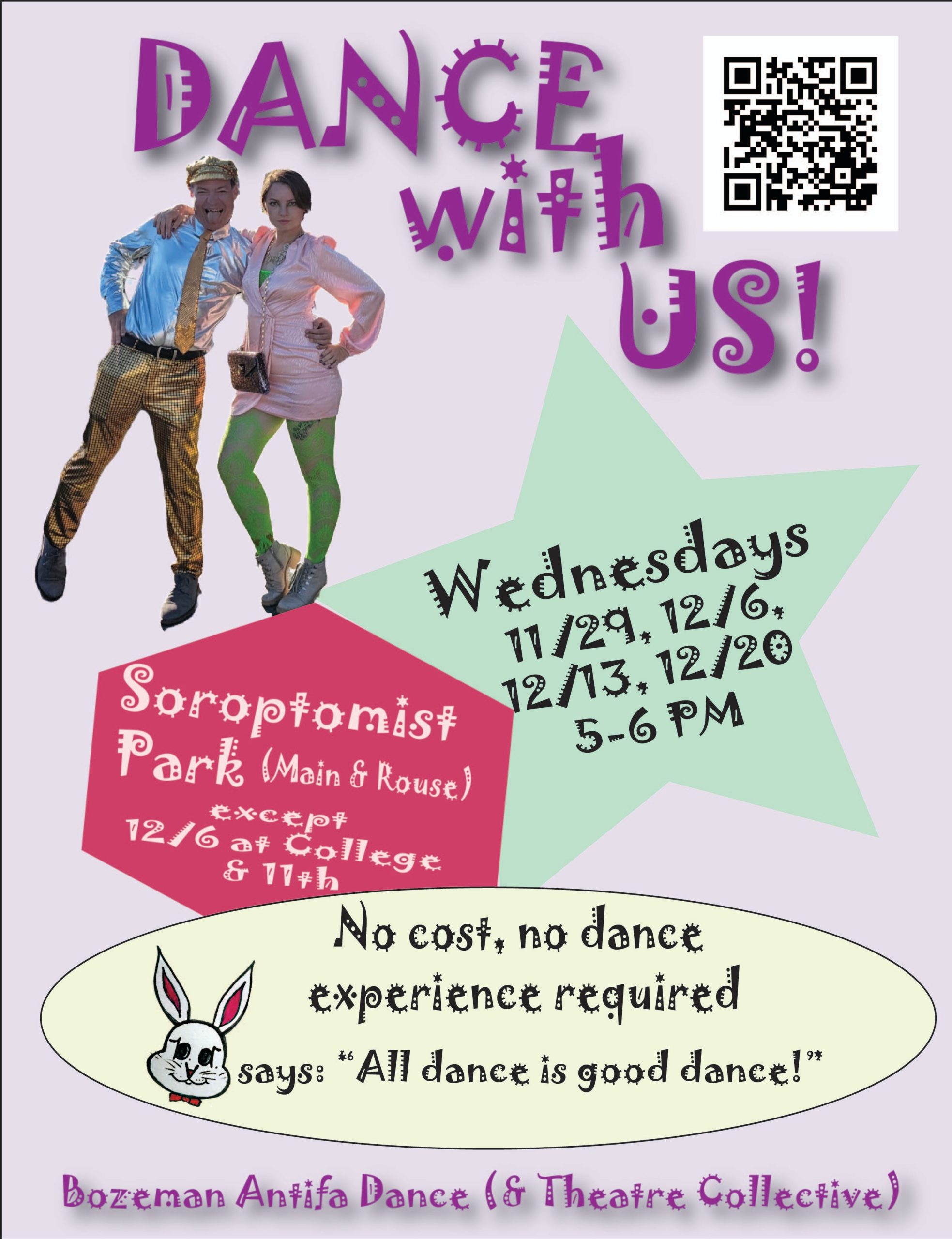
(download pdf flyer; download hi-res image) BAD is dancing every Wednesday over the next four weeks (11/29, 12/6/, 12/13, 12/20)! Join us at these free dances. You don’t need to know how to dance. We just dance. ALL DANCING IS GOOD DANCING! There are some things you should know or some questions you might have, and so check out our FAQ for more information. The dancing keeps us hot! However, you should still dress for the weather :).
Here we are dancing recently just to give you an idea of what it’s like to dance with us :).
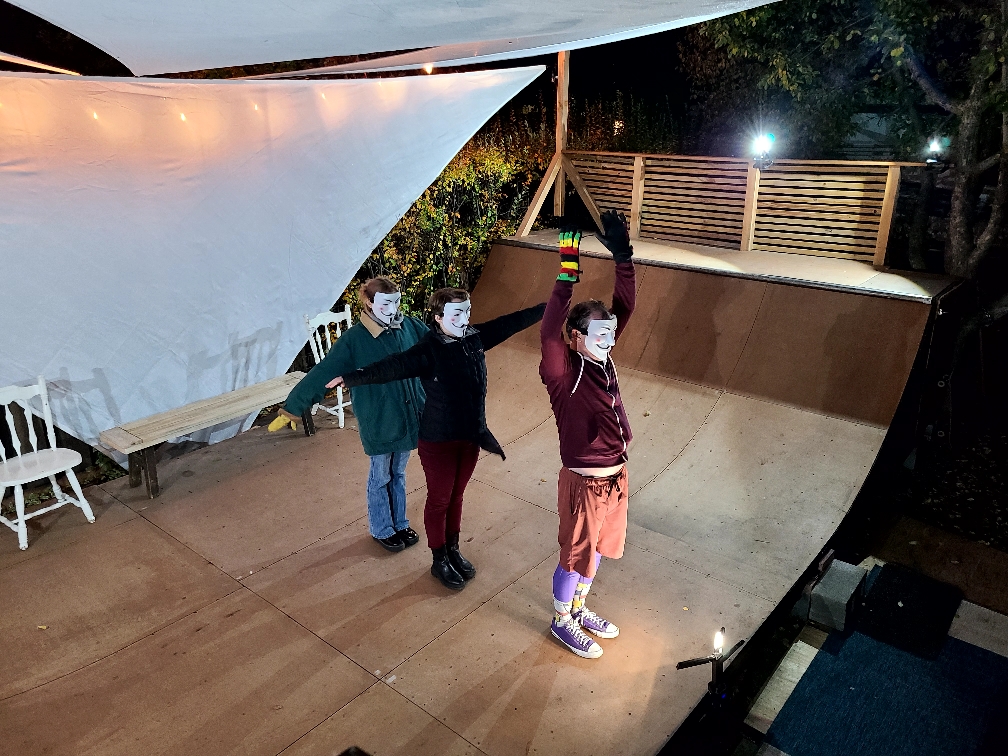
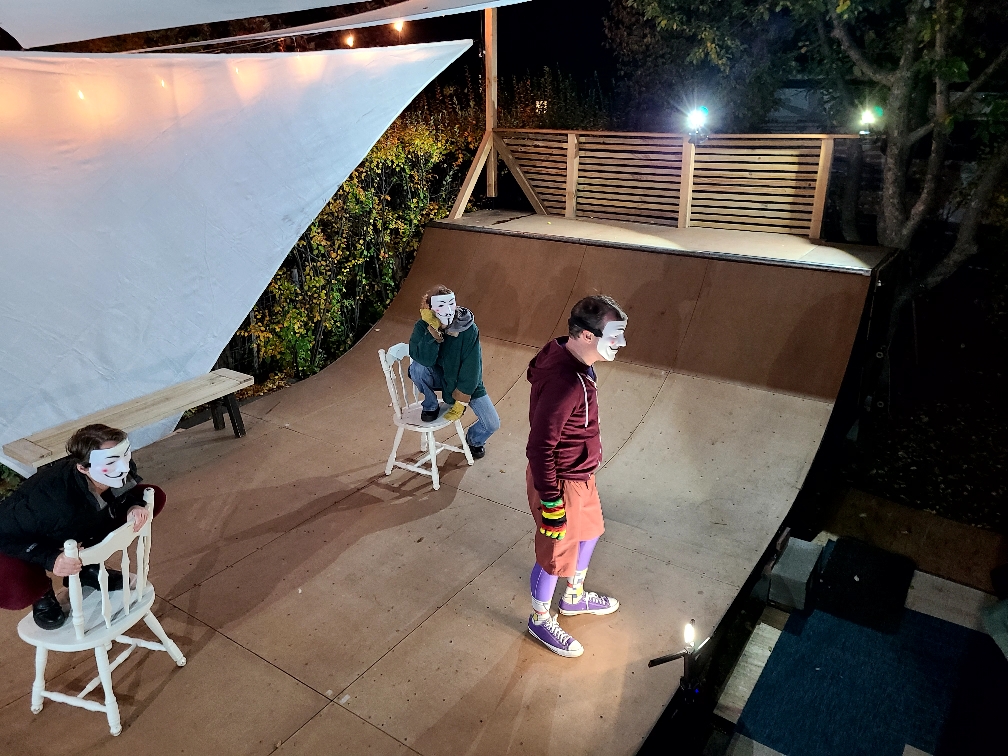
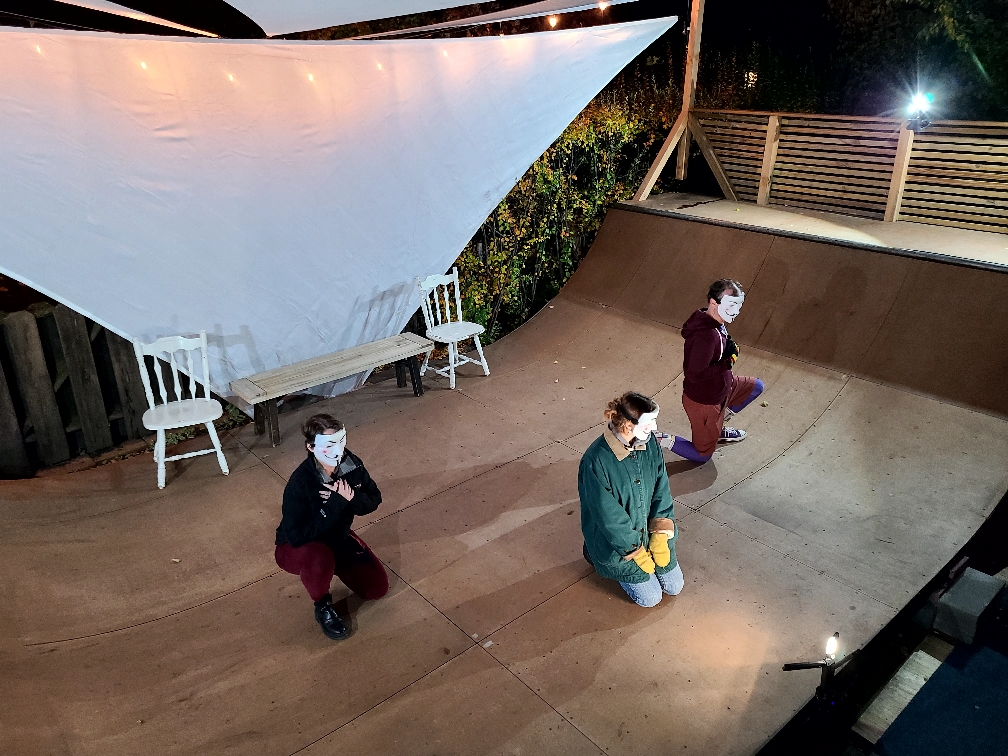
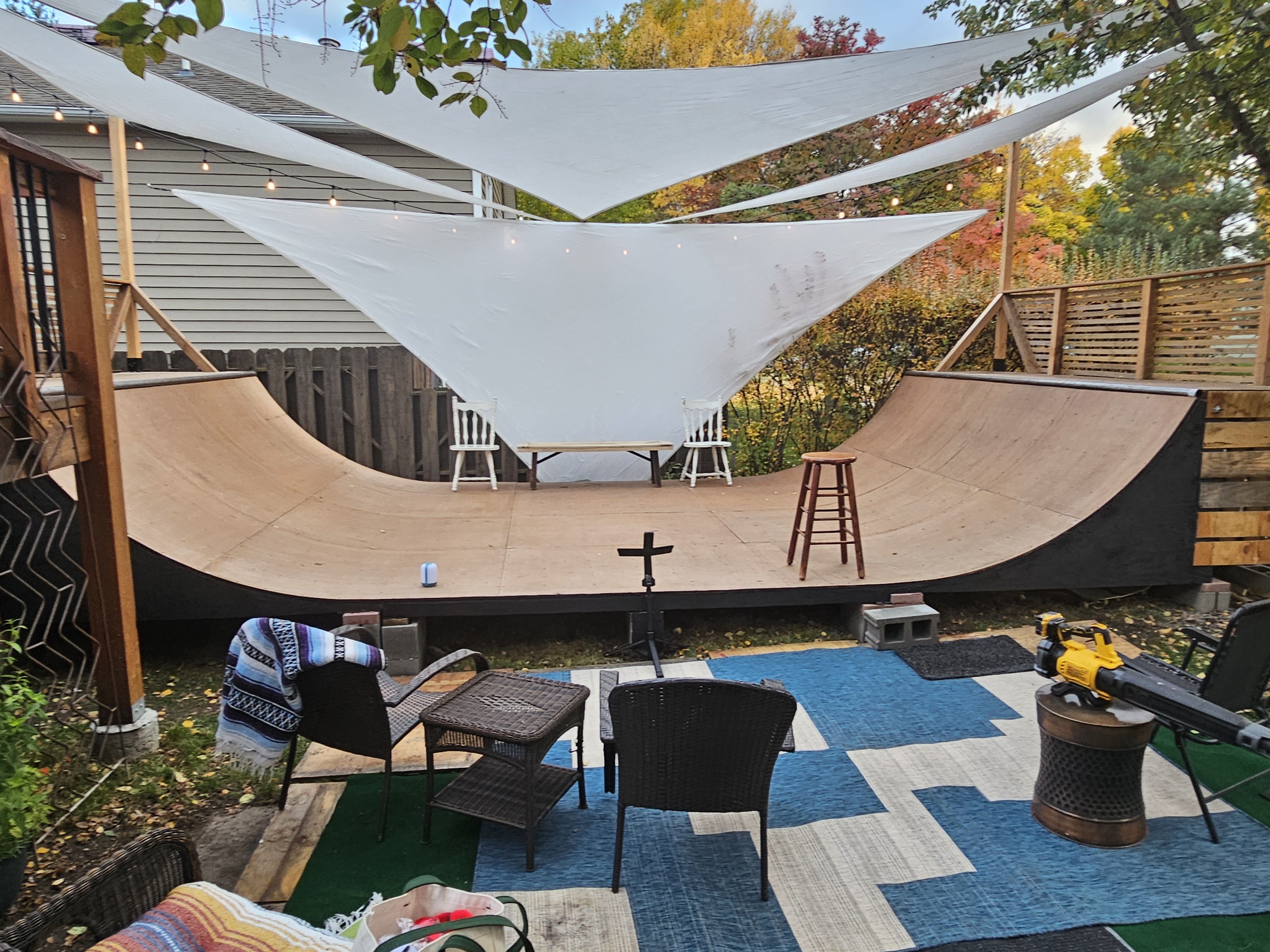
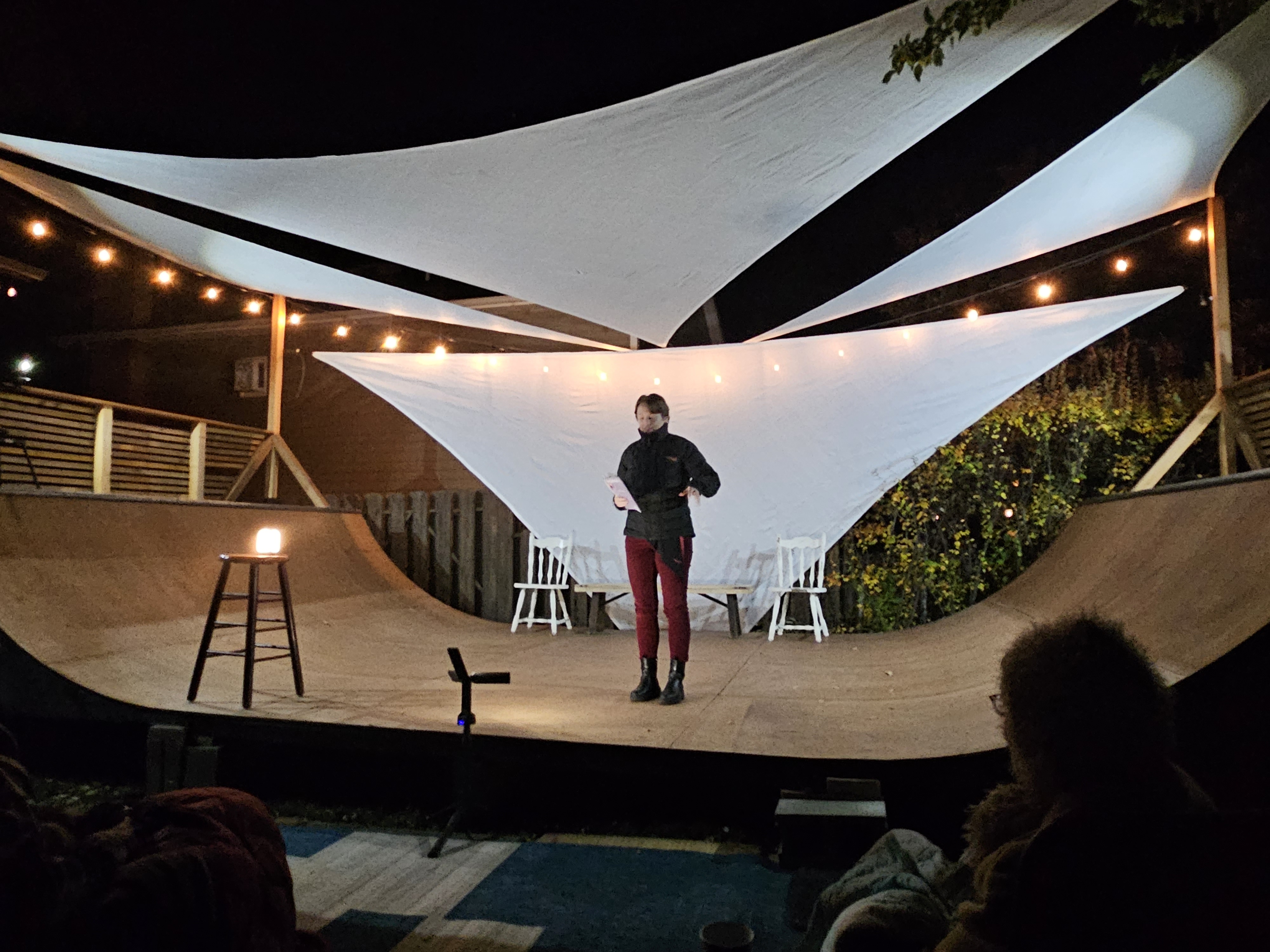
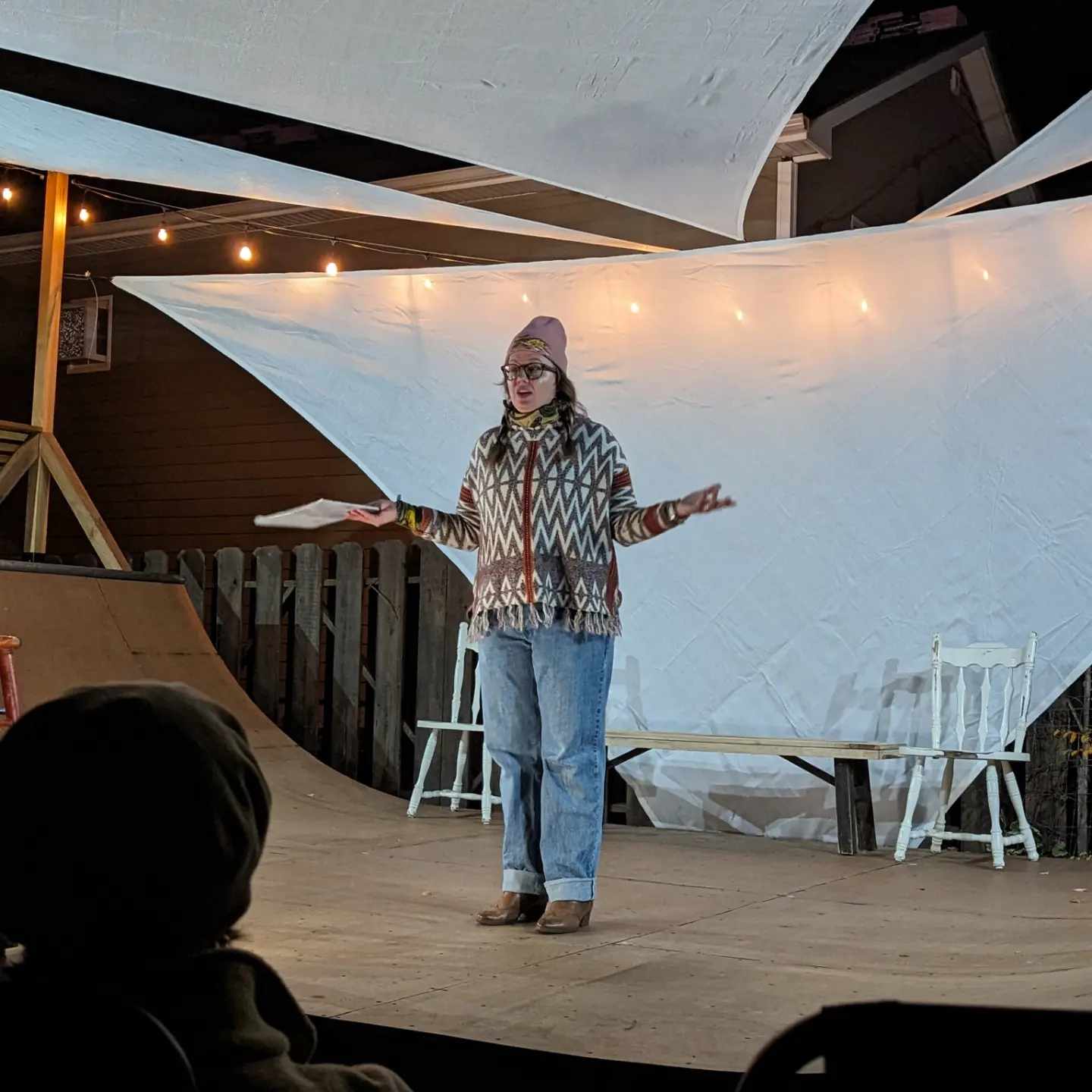
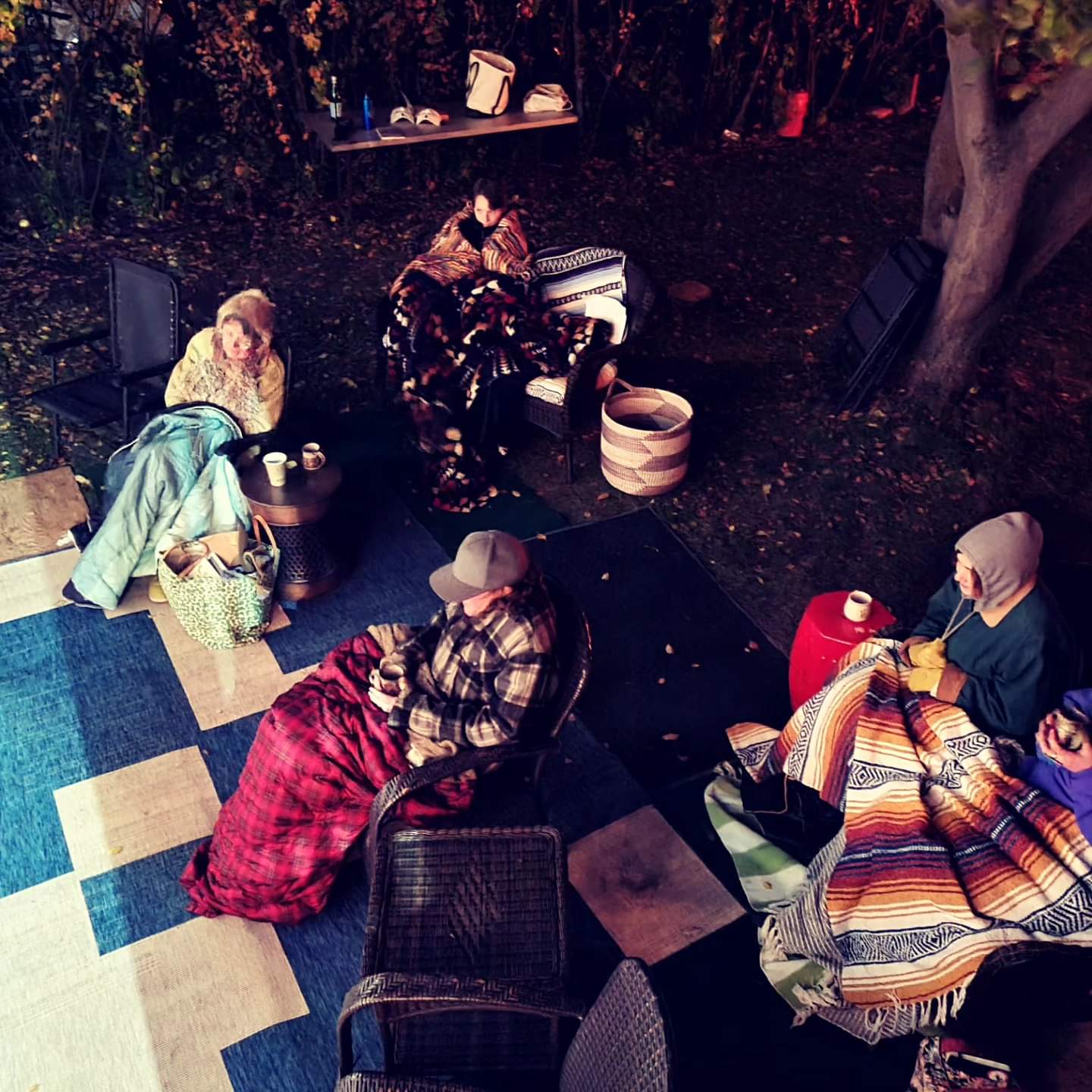
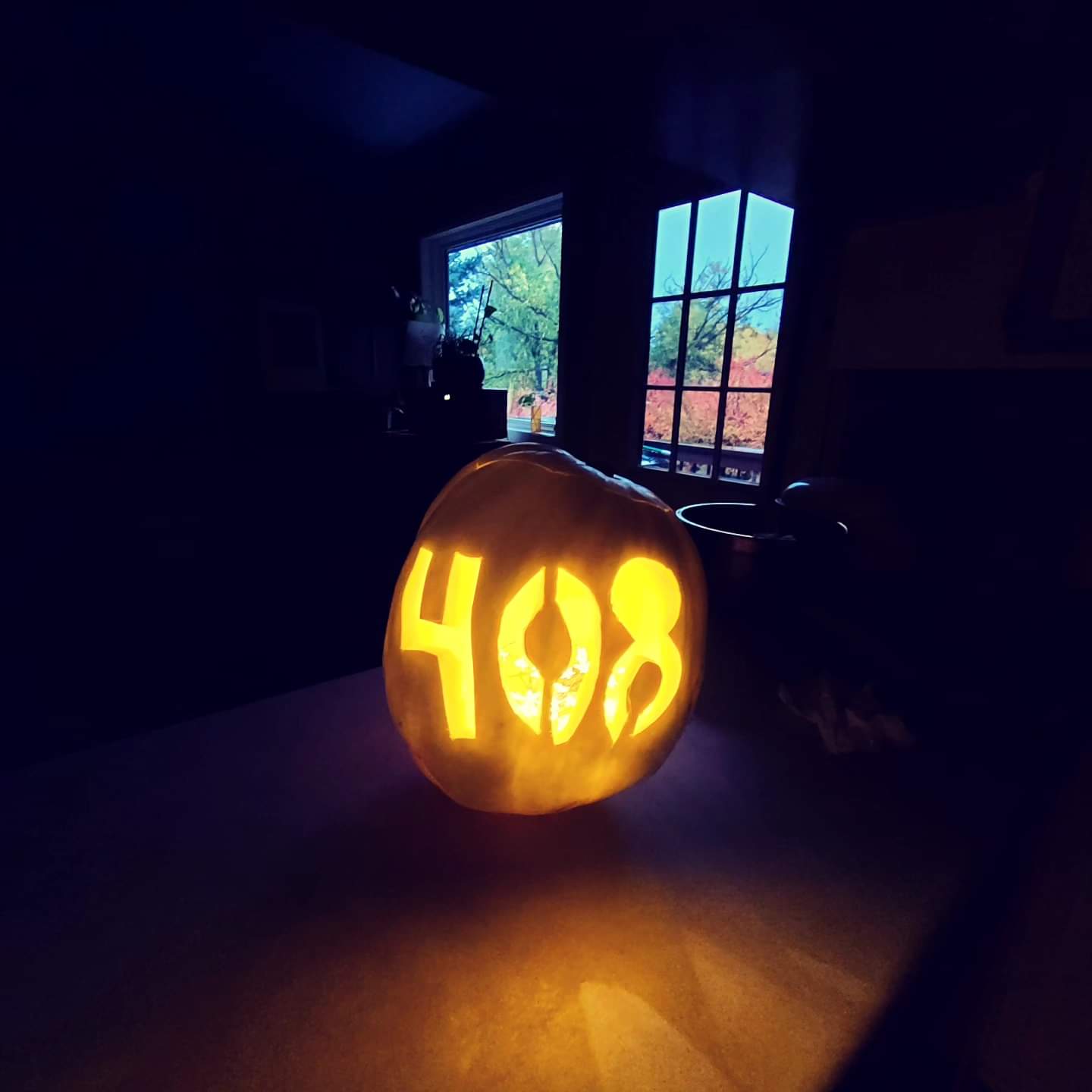
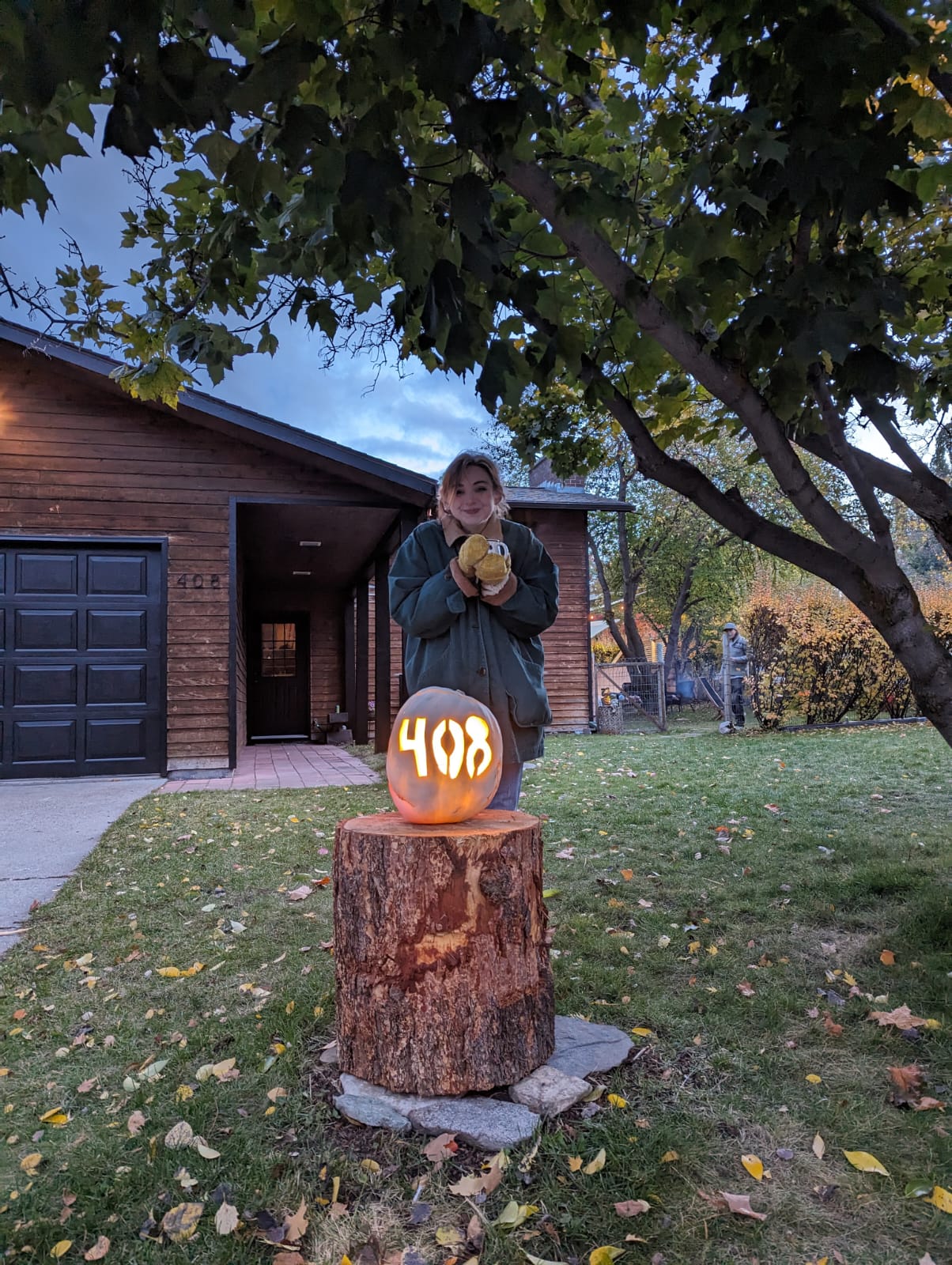
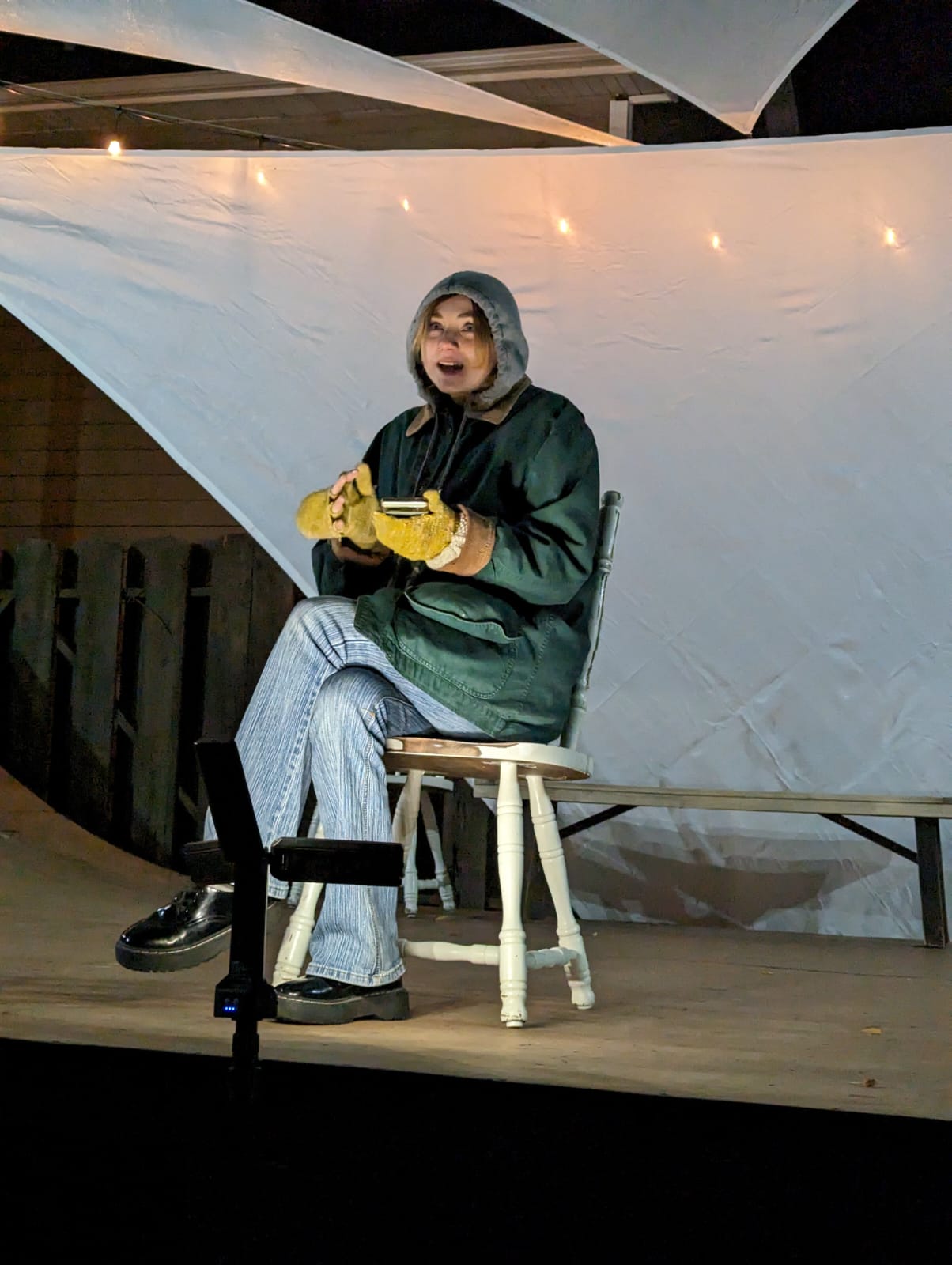
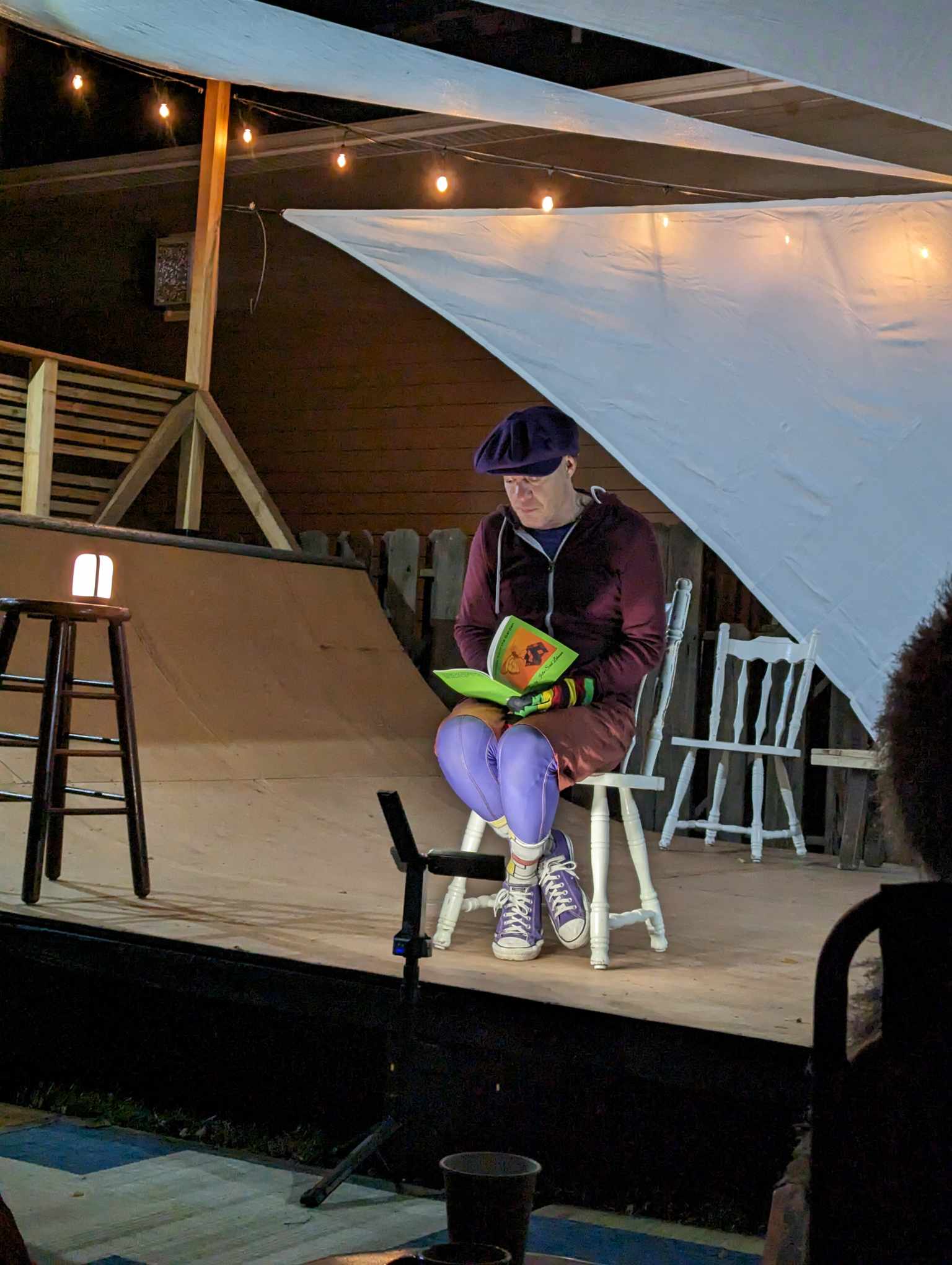
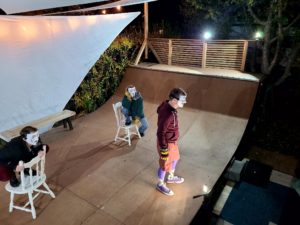
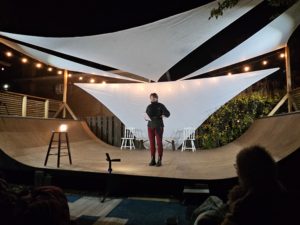
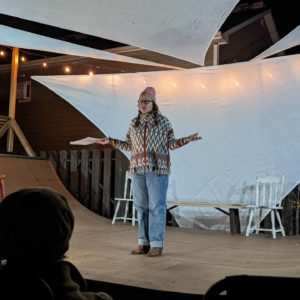
October 13, 2023, was such a frigid night on the remarkable backyard stage/skate ramp – christened “The 408” – hosted by Phaidra and Ryan, and yet I could not feel warmer in my heart to be performing with my friends.
Many people have this idea that artistic performance is only for those who can do it well. As an example, when my best friend Aly and I dance in public, we frequently hear some variation from passersby of “I can’t dance.” And when I perform improv on stage, I hear, “I could never do that.” Not immune to this idea myself, it is common for me to cringe at the pitchy sound of my voice singing.
Moreover, not only do the performers need to meet some standard of being good enough to perform, but also we assume that we must go to specific places for performance. We spend a lot of money to go to the movies, the playhouse, or the dance club. The idea that we can just break out into a song and dance routine anywhere sounds ludicrous, and it is even more so if you don’t have some special talent to pull it off.
The biggest reason why seems to be an overwhelming fear of judgment and humiliation from others or even perhaps oneself. We are so trained as to what is acceptable both in terms of societal behavior as well as the standard of acceptable quality that we are beyond hesitant to put ourselves on the line. If we do put ourselves publicly out there, it is usually in places considered safer for it, probably supplemented by a few drinks. On the dance floor, I often see it fill up only when dozens of people join at the very same time.
I would argue that this fear that keeps us back is an incredibly significant detriment to our quality of life. Break through the fear, and you will feel happier and more empowered regardless of who joins you. But if more did join us, society would see profound shifts across the board. At a minimum, we will feel much more joyful.
For some time, Aly and I have been involved in a community project – a two-person group – that we have called the Bozeman Antifa Dance (& Theatre Collective) – shortened to the cheeky acronym BAD. People’s eyes fixate on “Antifa;” obviously we know that they will. We know what a trigger word that is for right wingers, and just having that name in our group has been enough for people to give us death threats. While we are satirizing the idea that antifa needs to look and feel a certain way, of course we are stridently antifascist and have no tolerance for it in our community. We support anyone who acts against fascists and fascism. Yet, we are a dance and theatre collective. By tying dance and theatre to antifascism, we are making a further commentary about fascism and its dangers to our society. Fascism to us does not simply mean the racism and bigotry of neo-Nazis; it also refers to the radical conformity to particular norms that dominate our society. That conformity by itself is not fascist, but it lays the groundwork for a fundamentally fascist, unfree society. It leads us to limit our beliefs in what is possible for ourselves and for other people. BAD believes that if we publicly open ourselves up to free and creative expression without thought of how well it conforms to any particular societal standard while also opening up more spaces for that expression within society, we shall remove the ground that fascism needs for standing. Moreover, we will have a lot more fun, friendship, and connection.
Over time, as Aly and I have continued to free dance in public spaces, we have made more friends who want to play with us. One of these friends is a remarkable woman named Phaidra. Aly and Phaidra were in a show together at The Verge, and I met Phaidra through Aly. While BAD was doing our thing dancing everywhere in our colorful outfits, Phaidra and her partner Ryan were building a skate ramp in the backyard of their home. Only, it was not just a skate ramp; Phaidra, ever the free thinker, could see that the skate ramp could also serve as a perfect stage. With Ryan’s support, they figured out how to light the ramp at night. Their space allows for multiple angles to view any staging and includes various ways to enter and exit. Moreover, Phaidra had a vision where the community could come together in a judgment-free zone to perform. Basically, she shared BAD’s vision to radically democratize performance both in terms of accessibility of who can perform and where they can perform.
We obviously have all become fast friends, and so also including our larger set of friends, we have all decided to dance and put on shows together while also really connecting intentionally as friends who care deeply about each other. It has become infectious, and we have met others who feel the delight in doing something that is way outside the box and fills us each with incredible joy.
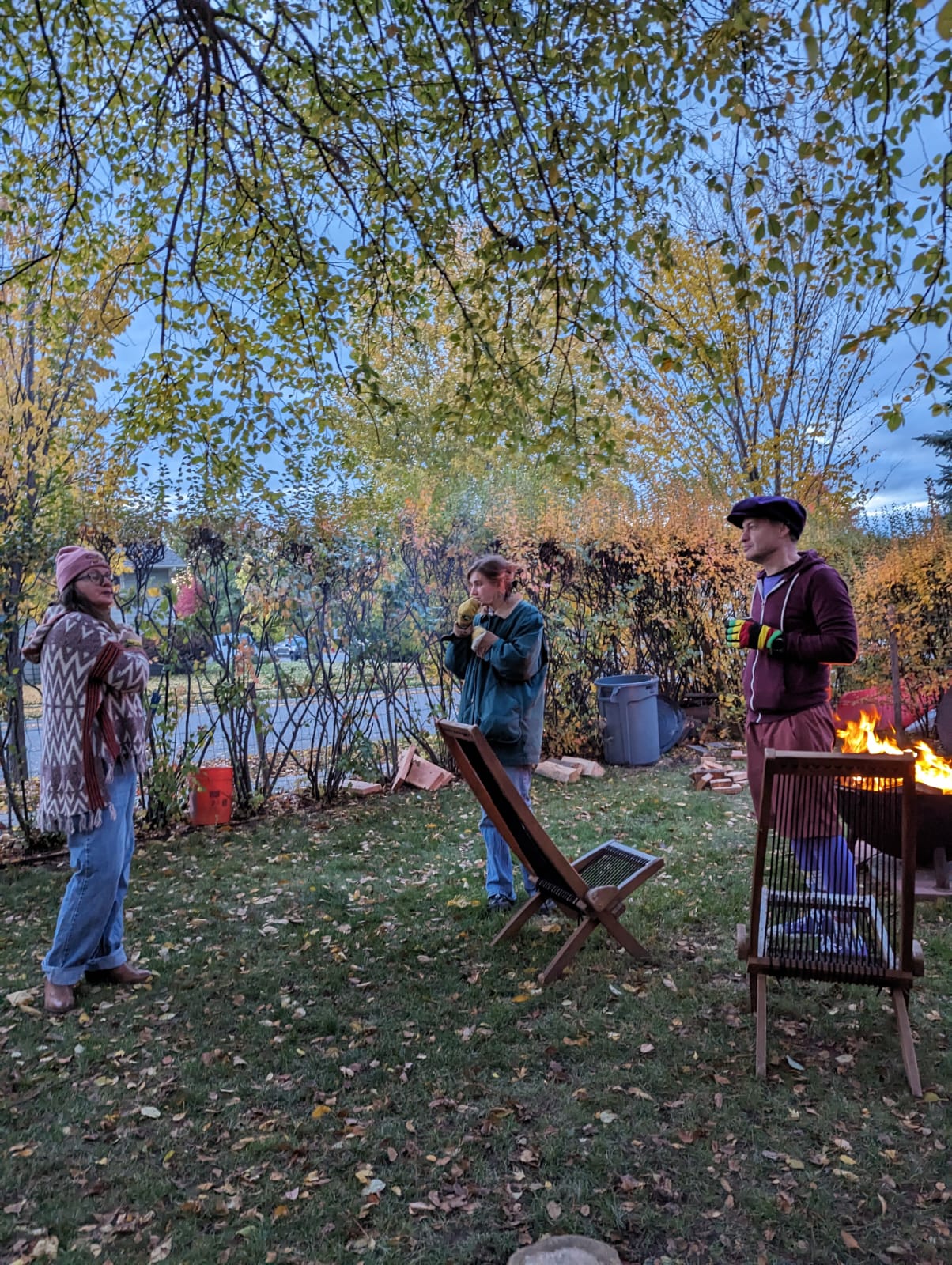
Last Friday, Phaidra and Ryan hosted the first open stage night. While it was cold, we stayed physically warm with a fire that Ryan built and some hot apple cider and tea. What really kept us warm, though, was performing with and for each other on this beautiful stage. Phaidra opened “The 408” with a beautiful and intimate speech thanking us for our part in making this happen and outlining the same vision I have outlined in this essay.
Then, a few of us did a little experimental skit that I won’t explain here because we don’t want to ruin the surprise of you seeing us on the streets of town doing it. Let’s just say that it mixes ragtime music and hacker Anonymous (that is, Guy Fawkes) masks.
Also, The 408 open stage featured remarkable poem readings, both original and unoriginal, all meaning a lot to the performer. One reading, by our newest and incredibly delightful friend Clara, came with some lovely performative flourishes.
Aly sang beautifully while I interpretively danced behind her, not knowing what she was singing prior to her singing it. This was not easy for me. Aly trained in her youth as an opera singer and meets the societally objective standards of a “good” singer, while I only started dancing at all in my late 30s. Besides a few swing dancing classes, no one ever trained me to dance. My body is terribly inflexible, and I don’t even like to keep the beat a good chunk of the time, inventing beats out of each melodic note. I love to dance, but I still found it difficult to go out there to a song I had never heard before behind someone as incredibly talented as Aly. Yet, I chose to live my principle, and I felt good supporting her knowing she wanted me to dance as she sang. It felt good just trying it out knowing that we were in a space attempting to create a culture of support. And while people said I did a good job, what really matters is that I chose to show up and be me on that stage with my friends.
We also did some improv, which put Aly outside of her comfort zone. But just as I supported her, she supported something I enjoy doing and had just done on stage the previous night at Last Best Comedy.
Performing continued after everyone left, too, when Aly, Phaidra, and I did some incredibly moving improvisational dance, much of it to Alanis Morissette.
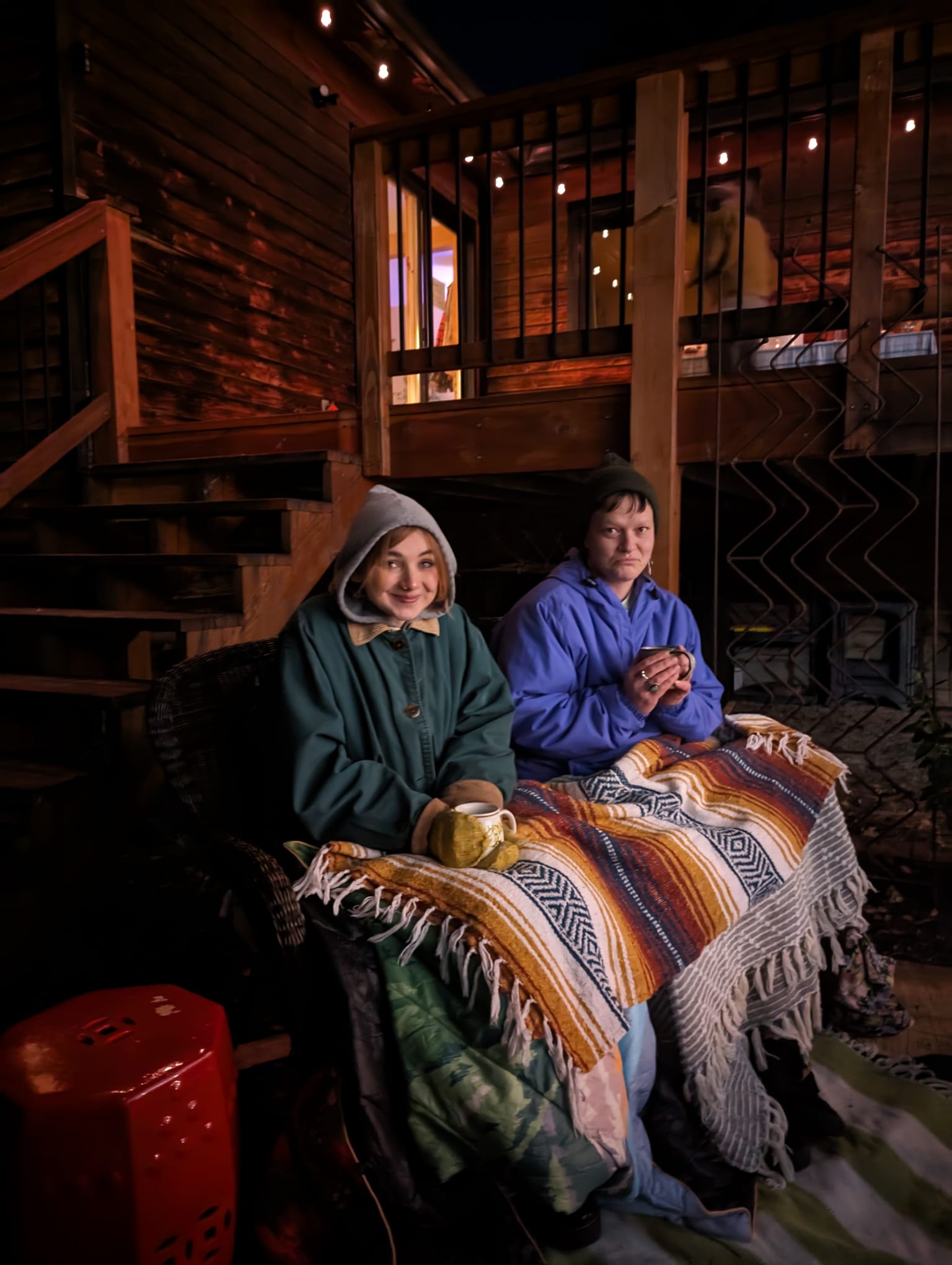
Was any of it any good? Who can say? But I can say definitively that it was good to be there with people who really wanted to be there and present with each other. It was so cold, hiding beneath blankets. Yet, in the power of the sharing, in the earnestness of witnessing each other, in just the audacity of performing for ourselves and for each other, I became so overwhelmed with joyful emotion.
After we left, apparently a neighbor had called the police, though we were done by 10 pm on a Friday night, were not using a sound system except a Bluetooth speaker to play some music, and apparently were not as loud as nearby neighbors sometimes are at later hours. Honestly, I could barely hear what people were saying from the stage mere feet in front of me. I am not sure why this neighbor could not have just come over. If they are reading it, it is not our intention to violate any boundaries. Let us just talk so that we can make it work for everyone. Just as we do not need to resort to the authority of society to tell us where we can and cannot dance, we surely can work out our issues over what can and cannot happen from each other’s backyards. As an antifascist, it tells me we have a long ways to go before we can undo the ways we have become alienated from each other in a radically conformist society.
We are going to keep dancing in public, and we are going to keep doing theatrical productions in backyards and on Bozeman streets. Whether it is Aly and I doing BAD or whether it is friends just tap dancing in the rain, we are determined to make our lives much more interesting and performative. We want to free our bodies to reclaim the entirety of our human nature. With free bodies in free spaces and with a growing community of support, we make it that much easier to inspire others to create a freely embodied culture – one where we are no longer limited by the fears that keep us conformed to a rather uninteresting set of societally acceptable options.
If this resonates with you, contact me, and we would love to have you join us dancing, singing, performing, writing, painting, screaming, crawling, or whatever your heart fancies. And if you only want at this point to witness, we could all use more friends. Let us all make beautiful art … together. Even on literally cold nights, we can dramatically thrive in a much warmer space.
When I ask most people how they define the word “anarchy,” they inevitably tell me that it means “chaos.”
However, anarchy doesn’t mean chaos; it literally means “without rulers.” We anarchists believe in a society without rulers, but that’s a broader idea than simply “without government.” That is because there are many ways some people rule over others than simply through presidents, prime ministers, and kings. Business owners and managers rule over their workers, and we anarchists are against that. Landlords rule over their tenants, and we anarchists are against that. Men in our world have traditionally ruled over women (whether that be husbands over wives, or just in the advantages and privileges that men have had over women), and we anarchists are against that. White people have ruled over people of color, and we anarchists are against that. Because of rules and social advantages, straight people have ruled over queer people, and we anarchists are against that. Able-bodied people have also ruled over disabled people, and we anarchists are against that. In most societies, people of particular religious beliefs have ruled over those with other religious beliefs, and we anarchists are also against that.
There are so many other power relationships, but I will define it in those broad terms right now.
As a result, being an anarchist is to be against hierarchies of power wherever they may be. Anarchism as a movement is anti-government, anti-nationalist, anti-capitalist, anti-property rights, anti-patriarchal, anti-racist, anti-heteronormative, anti-ableist, and anti-theocratic.
I suspect that many who read this would probably also be against many – though not all – of those things. If I had to venture a guess about society, most of us aspire not to discriminate based on gender, race, sexual orientation, ability, or religious beliefs. We clearly know of people who don’t believe in or want these ideals, but I suspect most do. However, I also suspect that most people in the world are, unlike anarchists, for representative democracy, are proud of their country, support some form of capitalism, and certainly believe in a right to property.
Wherever you are on the spectrum from anarchist to whatever the opposite of anarchism is, what is important to note here is that anarchism isn’t simply about being against all government. Rather, it is a critique on the nature of power relationships. We who are anarchists do not believe there is any just society structured around hierarchical relationships of power, and we have called for a social revolution to dismantle them.
How does anarchism propose to dismantle hierarchies of power and bring on a social revolution? Do anarchists imagine a rebellion of the repressed people to lead a mass uprising over the many ruling classes? Or perhaps, anarchists plan to use the existing levers of power to take power themselves and then cede it? Or maybe anarchists hope to disengage from political life altogether and convince people also to disengage, bringing about social revolution apart from society? Or maybe a particular class of the oppressed are best positioned, such as the working class and poor, to rise up and lead us all to social revolution?
Over history, some anarchists have tried some of these approaches, and others, such as using the levers of the system, have typically been rejected. Historically, a few anarchists have tried military solutions or other forms of militancy. Others have set up radical education systems, and still others have focused on organizing the working class not simply for better conditions for workers but principally to be a catalyst of social revolution for the benefit of everyone. There is no one anarchist approach to social revolution. However, what has typically been rejected has been running for office, forming political parties, or voting. Anarchists have feared that using the levers of power will only lead to new rulers, and anarchist rulers are not anarchists at all.
When I talk about anarchism with people, one of the common responses I get is that they, she, or he does not want to talk about politics. An anarchist does not want to talk about politics, either. However, it can seem like we do because it is impossible to talk about a ruling class without critiquing the politics that creates a ruling class. And yet, when I meet those who have no interest in politics, I often admire them. I wish we all could be so lucky and privileged as to be able to ignore the question. In most of our lives, we deal with and want to deal with each other as equals worthy of the same respect. However, in a society where we are not all so privileged, we must admit that we live in a system where some rule and others do not. That is, we live in a world where politics is a reality. What makes anarchism different from other social movements that critique our society is that we do not believe in a political solution to the problem of politics.
What do I mean?
I mean that politics is essentially about power. To know how to gain power over others is to practice politics. As I have defined it, anarchism is a critique of systems of power themselves. That is, we can say that at essence, anarchism is anti-political. Yet, I admit that we live in a political world where politics is a reality. Are anarchists also, therefore, anti-reality? Certainly, many critics have indeed argued that, but this is a fallacy.
Politics is a reality, but it does not mean that it must necessarily be real or that all of reality is politics. That is, we can also observe in our world many instances where we do not engage with each other through a power relationship. When I say “Hi” to my best friend Aly, and she says “Hi” back, are we engaging in politics? Yes, I identify as male; and she, female. I also have more money, and she has less. However, does she reply to me with a kind hello because I am empowered over her? That would be an extremely cynical understanding of the world, and I would be hard pressed to believe it. In most of life, none of us acts on the basis of any political relationships that exist in society. We know that those that do can be very dominating, whether it be a police or military force, the tax collector, one’s boss or landlord, etc. However, most of the time, whatever relationships exist, we do not act on the basis of our power. Those relationships and privileges are there, but we would be silly to the point of absurdity to think that even a fraction of what we do is because of politics.
Therefore, politics is a reality, but so are many other ways of relating to each other. Anarchism is therefore not anti-real just because it is anti-politics. What anarchists are strongly urging is that the greater the degree to which politics is in our life, the more it is keeping us from fully exercising all the other relationships that are or can be real in our society. That is, anarchism urges that if we lean into those non-political ways of relating, we will find that we can make politics irrelevant. As I noted previously, almost everyone agrees that at least in some ways we have political relationships with each other (between genders, races, etc.) that most people agree should ideally not be political relationships. Yet, the most common way that people in society have used to deal with these social issues is to engage in other political solutions, usually to change laws or to create economic incentives for change. However, what if we did not need to do these things this way at all? What if there were other ways of living and being that make politics irrelevant? Since we agree that a man and a woman can have a non-political way of relating even though we live in a world where men politically rule over women, we must admit at least that anarchism should not be dismissed out of hand for suggesting that a social revolution requires a non-political response to politics as a way to free us from it.
In this essay, I am not here to discuss how that’s supposed to come about. Ultimately, I’d love to give full expression to what that means, though I am doubtful I would most likely do that in writing. I am much more likely to express it through non-political lived experience that demonstrates anarchist ways of being. However, that is not to say that anarchism cannot be articulated. I just am not sure how much appetite I have to do it.
What I am here to do is simply argue for viewing the world through a lens that doesn’t automatically assume that there are political solutions to political problems. And because of that, I don’t want people to assume that when I talk or write about anarchism that I am writing principally about politics. Yes, it is about politics in that it is a critique of politics, but ultimately, anarchism is a social movement that aims to free us from politics. It’s about people and how they relate to each other in all ways and at all levels. It’s, yes, about dismantling the politics that keep people from free and equal relationships, but the ways to get there have nothing to do with the usual means people use. And I’d love to talk about my way of being an anarchist because I suspect it will be delightful and inspiring.
Yes, I realize we will need to discuss all we disagree about; there is much talking to do. However, if we can see through the usual tunnel vision in which we look at most social problems, perhaps there is a deluge of art and creativity to swim in as we demonstrate the social revolution envisioned by anarchism.
I wrote this poem in September 2021, reading it at an open mic poetry night over at the Steep Mountain Tea House. It was in response to police brutality here in Bozeman.
I hate the police
I hate police passionately Never met a cop I liked Hate how they beat black men in the streets With my own eyes, I once witnessed More than a dozen DC police Beating one black man
Now they also hog tie women Here in our town Here in Bozeman
But what I hate more than police I hate that we think we need them I hate that we think we have no power To take care of each other To protect each other To stand for justice together
I hate the radical disempowerment The powerlessness that people feel
And I hate that when another cop Assaults another person We think there are just a few bad apples Not that the system is rotten Not that we have given up our power To them To these abusive monsters
I hate the police And I hate that we think That collectively We can’t do anything about them
I hate that I will share this poem And you, you who sit there If you’re even listening Will think my radical words Unrealistic
Somehow, humans lived 150,000 years And only dreamed up police In the 1800s to protect property in the North To protect slaveholders in the South
And we think this is normal That we can’t live without them That we need them to protect us! Less than 200 years wipes out 150,000 Just like that That I’m the radical one When there’s nothing normal Sane, or conservative about a
Militarized police force
And sadder still, you’ll think that We are powerless That solidarity is useless That we can’t possibly do anything Such a self-fulfilling prophecy Or you’ll vote You’ll vote for someone else To take the power from you And hopefully do the right thing And when they don’t You’ll vote again And again And again And what will ever change When did any significant change Happen by voting? What if MLK and Gandhi had decided To wait for someone else To make change and simply vote So, I hate the police And I hate that so few of us Believe in us In all we can do together But I still believe So, if you still believe
This is our 10th episode, and we (Aly and Jim) go into our roots as an antifa dance (& theatre) collective, discussing why we believe what we do in street dancing, art, and theater are revolutionary antifascist activities just as vital to a revolutionary movement as other forms of direct action. We play around with surrealism, too, but we also discuss our broader interests. As full humans, movement and expression is vital to us, but just as we rebel against limiting forms of activist expression, we do not limit our activism to art. In that light, we discuss a recent essay that Jim wrote against an urban camping ordinance proposed here and the general lack of respect people who don’t have homes receive. The thread of all our discussion is breaking patterns of conformity in all aspects of our existence.
If you listen to this episode in the week it is published, we invite you to a public street dance (no cost, no dancing experience, no fascists) at Bozeman’s Soroptomist Park on Saturday, September 16, 2023, at 11 AM. If you can’t make it, contact us and suggest times that may work for you (or organize a dance and invite us!)
I wrote this on May 8, 2005 (slightly modified on May 9). It really is a typical report of small actions we in the DC Anti-War Network would do and the kind of reports I would write about them. - jsm September 19, 2023
***
A report by on DC Anti-War Network's (DAWN)'s action at the Department of Defense's military display on the National Mall. At these displays, young children actually played with unloaded military weapons. Also, a brief report from DAWN's and MGJ's action honoring the successful hunger strike by students in Georgetown fighting for a living wage for school workers.
Today, we had an intense little action on the Mall, where the government was celebrating public servant's week, and where the Department of Defense set up shop to show its toys to the world.
We caused a stir out there today, and I want to thank Jose for suggesting this idea. It was well worth it.
About a dozen of us (counting comers and goers) were out on the Mall today for DAWN's action, which was in part a protest against U.S. militarism, in part an outreach and education opportunity, and in part a working group meeting of the Draft, Counter-Recruiting, End Stop Loss (DCRESL) group. We came equipped with flyers that John graciously supplied us with as well as signs directed against the military displays on the Mall.
At about 1:30 PM on this very sunny day, we headed from the Smithsonian Metro to the tents on the Mall across from the Air and Space Museum. After chatting a bit with Jose, we did our best to get into the exhibits and display our messages, while talking with people.
The exhibits themselves were fenced in, and so to enter them, we needed to pass through metal detectors. As we started to go through, some of the security began noticing the signs. At first, they let us enter. Genevieve got through, but we started having troubles once Eric and David tried to go through. Then, security let us through, but immediately after going through, another police officer stopped us and said that we would have to take the signs outside. We discussed with him a minute why he was doing this, and he claimed it was because this was a "DoD (Department of Defense) event." Unsatisfied, I asked him if he had written confirmation of the rule. The reason I asked him this was because I was sure there wasn't since the signs became a part of an informal conversation between the security people. They let people through, and then they didn't, and then they did again. I suspected it was an "on the spot" decision. Naturally, he said there wasn't a rule.
Dave and Eric decided to abide by the rule, and they set up with their signs right at the entrance. In the meantime, I wasn't carrying a sign (apparently a shirt that said "No War" was okay...Luke was also able to get through with a Bush chickenhawk shirt was also okay). It's not clear why or why not; these things are pretty arbitrary.
I quickly walked to try to catch up with Genevieve (who had her sign) and with Malachy. As I walked briskly, I noticed an incredible montage of military displays from all the branches of the service. There were military bands, military displays, military weapons. In some cases, young children were being encouraged to play with the guns. As I made my way through this maze of militarism, I finally found myself outside where there were all kinds of military heavy machinery, including heavy artillery and armored personnel carriers. My eyes finally caught sight of Malachy and Genevieve. I got to them, and no sooner did I tell them what had happened than a security personnel came to Genevieve and told her she needed to leave her sign with him.
"I'm not leaving my sign with you!" She moved away from him. He said that if she didn't leave her sign, she would have to leave. She went over to an armored personnel carrier where I took a couple pictures. At that point, five troops around the carrier began to mock her and tried to get in the picture (which I was happy to oblige). The security person again approached her as Genevieve began to have a very heated exchange with the five troops. The security person came up, and Genevieve agreed to be escorted to the exit as I continued to flash photographs.
We exited, stood there for a short time (noticing that some tourists entered through the exit, thus avoiding the metal detectors when sometimes as many as five troops weren't paying attention). We soon joined our friends and spent the next couple of hours in front of the entrance.
There, we felt a great deal of obvious animosity, but you'd be very surprised what happened in small private moments. One man wearing a badge that said "DoD Exhibitor" came up to Genevieve and said in her ear, "Thank God you all are out here." A soldier at one point whispered quietly into Malachy's ear, "You're right, you know? I just can't say anything out loud or I will get into a lot of trouble." We had our pictures taken with high school students from Baltimore, and several passersby expressed sympathy. Nevertheless, more often than not, the scene was tense and hostile. At least one or two men threatened violence, but no one backed away.
Most of the flyers ultimately disappeared as we handed them out to those who were interested. Some from Codepink also came and joined us.
We only decided to meet when people decided they needed to get going, the reason being that an action seemed a lot more effective than another meeting.
Personally, I sometimes think in heated exchanges that we don't always show much discipline, shouting down and bullying those who disagree with us, and sinking our arguments to the lowest common denominator. We shouldn't always be as quick witted as we are, practiced in talking. I think, though, on the other hand, that people need to see our passion. And, I resent the implication that we are crazy. We spend billions and billions of dollars on killing machines, glorifying it to our kids, and treating them like toys, and we're supposed to be the ones who are insane because we carry a couple signs and make a little bit of noise?! Something is hopelessly out of whack, and I'll take our craziness over the craziness of these death machines any day.
Good actions arouse passions, whether they be anger or sympathy. I think we can do more to raise the relationship with our opponents to a higher level, but no one can deny that this action was provocative. We were able to interact with real soldiers, real supporters of militarism, and find people willing to feel and care for something, even if they found what we were doing dispicable. Others were inspired by us, like the young couple from Palestine that we met.
Seeing the disgusting display of militarism on the Mall aroused passions in me. Seeing children playing with weapons aroused something in me. It made the cycle of destruction that we are perpetuating all the more tangible inside of me. It was empowering for me, not just because I could participate, but to witness the courage of our friends. Some expressed openly to the police that they were willing to face arrest, and as Genevieve put it, that our belief in this is that strong.
Later at the student networking session honoring the Georgetown Living Wage activists one young woman from the Friends Committee on National Legislation said to Malachy and I that during the Nuremburg trials that there were experiments carried out which showed that people don't so much go to war and obey the law so much because they are told or because they are scared not to but because they had been habituated to carry out those kinds of actions. I quipped back to her that we suffer from a bad national habit, then. And, indeed we do. It will take a lot of resistance to change the culture of that habit. We can only hope to make a dent by being in places like we were today, challenging the military might right in its face. It won't be pretty at first, but over time, through our commitment, through our suffering, we can break this horrible national habit.
That's all for now.
Jim Macdonald
PS The student networking session honoring the Georgetown Living Wage activists was a wonderful event put together by DAWN and MGJ, and I think Chris did a fantastic job. Malachy and I met so many student activists from groups I had no idea existed. They've compiled these names and groups, and we'll be staying in touch. That action was equally important to our ends even though the vibe was completely different than the vibe on the Mall.
It was a fantastic start in movement building. Without relationships, there can be no solidarity. Without solidarity, we have no movement. While hardly as dramatic as this afternoon, I hope that we appreciate the hard work that goes into making the relationships that will make direct actions like the one reported above more effective.
This piece was published in DC Indymedia on August 30, 2005. Here you see me maturing in my anarchism and deep in a fight against national organizations like UFPJ stepping on local grassroots organizing. By this point, I am fed up with the national anti-war movement. Ever since this experience, I have been an anarchist not only against the state and capital but also against the governance and hierarchies that develop to co-opt social movements. UFPJ was a prime example of a national organization that was a state within the anti-war movement, supported in part because they were better than the Stalinists down the street and certainly better than American imperial government. But it gave me a hard lesson as to why anarchists only run into trouble when they build coalitions with statists. - jsm September 19, 2023 P.S. And, you should read the internet archive of the comments - quite the freaking discussion! - DC Indymedia Archived Article
***
Have you ever been in a place where everyone seemed happy and engaged, and the happier and more engaged they seemed, the more you felt like oozing into the center of the earth never to be seen from again? That's the way I felt last night at the UFPJ DC organizing meeting.
On the face of things, it was a great meeting. Over 70 people came to organize and listen to Ray McGovern and Tia Steele. I can't say that Ray or Tia were disappointing speakers at all, and they not only meant well, they spoke well. But, you see, by that point, I was already feeling way off.
The meeting was in the Communication Workers of America building. The room was set up in a large square with seats at a square table with another row of seats outlining three corners of the square around the perimeter. Besides being cold, the room felt something like a board room. It was pretty clear where the front of the room was and where the hotshots would be sitting.
In my own strange characteristic defiance, I came straight from work wearing shirt and tie. Usually, I stick out like a sore thumb, which often amuses me, since in the activist setting I’m accustomed to, there’s an air of rebellion in wearing the tie. I don’t always wear the tie, and it’s not my costume of choice, but I resent the thought that I should have to change after I leave work and that I can’t feel comfortable in any skin I find myself. Well, last night, while no one else was wearing a tie, I somehow felt a lot more like my clothes fit the occasion. That’s not really so bad. And, that’s not the point. Yes, the demographic was different, a little wealthier, but so what? If people are themselves, let them be themselves. What I think it was really was the context of it all in terms of UFPJ. Over and over, those of us who have been working on opening up UFPJ’s process and making it more democratic have been criticized relentlessly for not being diverse enough as a group, lacking a significant number of people of color, especially, and the veiled suggestion that UFPJ needs its hierarchical structure in order to make sure that voices that have been traditionally silenced have a chance to step up to the plate. If you open up the process, the assumption is that you only open up the process for people who have been traditionally empowered. Yet, looking around, I didn’t see a lot of diversity except that at the front of the room, you had two people of color leading the meeting. While by some definition, that’s diversity and re-balancing the power equation, I think many would simply call that tokenism. And, looking in this room, knowing the criticisms that have been levied against efforts that I and others have been a part of, I no longer felt comfortable in my own clothes.
If numbers are any indication, UFPJ’s organizing should be a success, but at the cost of movement empowerment. The meeting after the presentations, which I will reiterate were pretty good, consisted of a series of report backs, a call for volunteers, and a pitch for donations. At a few moments, people edged in with clarifying questions. However, there was nothing to decide, no way to plug in creatively, and no sense of ownership. The people who spoke in some ways owned the event, and even some of them were less owners than others.
People seemed genuinely energized by this, perhaps sensing the numbers, sensing that Cindy Sheehan’s vigil had given people a sense that a turning point was near, but I continued to feel a real sense of distress. Here a local movement had been co-opted effectively by the promise of bigger numbers, by the celebrities, by the name recognition. It promised little slices of pie to people, often in the name of an endless series of tents, if only we can come together to stop the war, which now seemingly must come to an end. The big problem with this big tent was that voices were lost in the process. There is a horrible contradiction in working toward lifting up the voices who haven’t been heard when there is no process in place that guarantees that those voices will be heard. So, what you end up having are the dominant patriarchal (patriotic) sections of society wreaking a kind of unwitting havoc on anyone who dares to be different.
What do I mean by that last sentence? Let’s look at some concrete examples. UFPJ, through a long and arduous process, had promised legal support for nonviolent direct action planned for the weekend of September 23-26, even if it wasn’t part of the action that UFPJ was organizing. That was all fiction last night. When the question of legal came up, it was clear that UFPJ was providing for legal support only for actions on September 26. Those who had rebelled had been quietly pushed aside when the sham process reached a sham decision (much like many of the decisions of UFPJ’s national assembly in St. Louis). What about a convergence center as a means of supporting and showing solidarity with those actions? UFPJ’s stock answer was that it was likely that the tents would serve as a convergence center. Under whose control? UFPJ’s. Would housing be allowed there? Absolutely not. Would UFPJ then help provide money? Probably not. Talk with Leslie Cagan. Okay, what about Operation Ceasefire, that great event that is being put together to support UFPJ and DAWN. Well, don’t look now but DAWN isn’t mentioned much anymore in Operation Ceasefire. I guess money talks. And, capitalism is alive and well in the peace movement, where return for investment must correlate to amount of investment a group can offer, and any attempt to rectify the power dynamics to something more equitable and more in line with grassroots organizing is out the door whenever it is convenient. Expect the peace groups with resources to have even more, and those who don’t to have the nothing but human volunteer power that they started with. But, damn it, after all of this, volunteer! Give money from deep inside your pockets! Stop the war (in Iraq)! Put the Palestinians off in Farragut Square…sounds like a winner! In other words, daring to stand up against the hierarchies of decision-making leads you to be pushed aside, ignored, dropped away, tokenized, or highlighted somewhere else. Who can stop this (anti-)war machine?
I’m really glad I went last night, but I won’t be coming back. I’m angry. I’m mad. I’m mad because I find myself having to work for the movement, and right now working for that movement means supporting all the options possible, and that means helping bring people to this event. Since people coming don’t give a damn about UFPJ, ANSWER, MGJ, DAWN, or anyone else, and are (to use Ray McGovern’s talk last night “unreasonably patient” with the voices in the movement) looking for a voice, I’m going to have to work like mad to give them that opportunity. I have to help them find housing, help getting around, the best information on actions, the best anti-war and global justice literature that I can find. But, I’m mad as hell because the big lie is that all this is not even close to what it should be, and we are propping up hierarchical, disempowering processes in order to fight them. The contradiction is maddening.
The evening finished with breakouts into working groups. Many of us harassed our friend Jose about the issue of a convergence space. It was comedy of the absurd. Jose has no power over the issue and no influence on it. But, we let our poor friend have it because there was nothing else to be done. To get stuff done you have to schmooze the right person, and I think all of us going there knew that in advance. But, we don’t have endless hours of the day to play political games. These meetings are billed as organizing meetings, and that’s when we can come. We can’t go to New York, can’t be on the phone all day, and many of us are increasingly disgusted with dealing with the feudal lords who are in power.
This is not sustainable.
This weekend I will go to New York, and we will be talking about the weekend and working on the alternatives, not just in terms of action, but in terms of organizing and empowerment. I hope we consider this seriously, and consider not allowing ourselves to be co-opted ever again.
This call to action I wrote for DAWN in November 2004 (published in DC Indymedia on November 30, 2004)
It makes me cringe now, but this ended up being a significant action in a beautiful decentralized protest that brought out between 10-15,000 people. It was the model of the organizing we wanted to do that was different from what the big national organizations did (UFPJ and ANSWER), who were both Communist front organizations, one more liberal and more Stalinist, but both different than our anarchist-inspired approach. I wish the Call to Action were a bit more anarchist, but it definitely reflected the diversity of our network in DAWN. My own radicalism was still in process.
-jsm September 19, 2023
RISE Against Bush
SHINE For A Peaceful Tomorrow
A Call for Anti-War Actions in Washington, DC, January 20, 2005 Every morning, the sun rises up, penetrating and overcoming the darkness of night. What once was dark becomes bright, changed by the force of the sun's rays.
Our world is in darkness tonight, plagued with war, poverty, environmental destruction, and attacks on many of the liberties that so many of us hold dear. The darkness over our world has grown yet darker with the election of George W. Bush to another 4 years in office. In the dark of the night, we need only wait for the sun. However, in the dark of our world, we cannot wait. If we are to see a new dawn, we must take action now. The DC Anti-War Network (DAWN) calls on the people of the world to RISE Against Bush and SHINE For A Peaceful Tomorrow.
We RISE
Against the needless slaughter in and occupation of Iraq;
Against the assault on civil liberties, as represented by such acts as the Patriot Act and the immoral detentions at Guantanamo Bay;
Against US support of the Israeli government's denial of human rights against the Palestinian people;
Against U.S. overthrow of Aristide in Haiti;
Against U.S. attempts to overthrow any other democratically elected leader, including Hugo Chavez in Venezuela;
Against any U.S. military action in Iran.
We SHINE
For a world that embraces peaceful dialogue instead of war;
For a world where we respect the liberty of all beings;
For a world that looks out for all those who are now oppressed, including the poor, women, racial minorities, workers, the disabled, gays, lesbians, bisexuals, transgendered, as well as the earth and its creatures;
For a world that embraces social justice;
For democracy and the autonomy of all people to have a full say in how they are governed;
For each other.
The Call DAWN calls for people all over the nation and world to converge on Washington, DC, on the day of George W. Bush's Inauguration, January 20, 2005, for peaceful anti-war actions. While DAWN is coordinating with many groups for a day of actions, DAWN calls additionally for these specific actions:
A permitted nonviolent anti-war rally followed by a march to Bush's inaugural parade route;
A nonviolent civil disobedience die-in, following the rally, in memorial to the dead at the hands of Bush and his Administration.
DAWN also calls for organizations, affinity groups, and individuals to partner with us in organizing these two actions.
Next Steps If you or your group or organization wants to endorse DAWN's call to action, please send an e-mail to info@dawndc.net. Write also if you wish to collaborate in the planning or offer financial donations or other material support.
Find out more information about DAWN's and other groups' actions at http://www.counter-inaugural.org, by participating in the DC Cluster Spokescouncil meetings (refer to website), or by participating in DAWN's weekly meetings. Check our website, http://www.dawndc.net for more details. Housing boards, events boards, working group information, and (soon) ride boards can be found at http://www.counter-inaugural.org. We will post updates of our actions, as they become available, to that website.
The new dawn begins with our rising up. It will take a lot of light to break through such darkness, but we can do it. We have no other choice. Join us on J20!







 The biggest reason why seems to be an overwhelming fear of judgment and humiliation from others or even perhaps oneself. We are so trained as to what is acceptable both in terms of societal behavior as well as the standard of acceptable quality that we are beyond hesitant to put ourselves on the line. If we do put ourselves publicly out there, it is usually in places considered safer for it, probably supplemented by a few drinks. On the dance floor, I often see it fill up only when dozens of people join at the very same time.
 Over time, as Aly and I have continued to free dance in public spaces, we have made more friends who want to play with us. One of these friends is a remarkable woman named Phaidra. Aly and Phaidra were in a show together at The Verge, and I met Phaidra through Aly. While BAD was doing our thing dancing everywhere in our colorful outfits, Phaidra and her partner Ryan were building a skate ramp in the backyard of their home. Only, it was not just a skate ramp; Phaidra, ever the free thinker, could see that the skate ramp could also serve as a perfect stage. With Ryan’s support, they figured out how to light the ramp at night. Their space allows for multiple angles to view any staging and includes various ways to enter and exit. Moreover, Phaidra had a vision where the community could come together in a judgment-free zone to perform. Basically, she shared BAD’s vision to radically democratize performance both in terms of accessibility of who can perform and where they can perform.
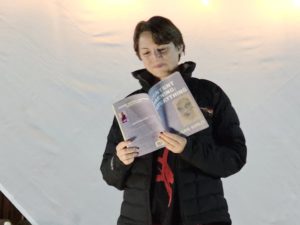 Aly sang beautifully while I interpretively danced behind her, not knowing what she was singing prior to her singing it. This was not easy for me. Aly trained in her youth as an opera singer and meets the societally objective standards of a “good” singer, while I only started dancing at all in my late 30s. Besides a few swing dancing classes, no one ever trained me to dance. My body is terribly inflexible, and I don’t even like to keep the beat a good chunk of the time, inventing beats out of each melodic note. I love to dance, but I still found it difficult to go out there to a song I had never heard before behind someone as incredibly talented as Aly. Yet, I chose to live my principle, and I felt good supporting her knowing she wanted me to dance as she sang. It felt good just trying it out knowing that we were in a space attempting to create a culture of support. And while people said I did a good job, what really matters is that I chose to show up and be me on that stage with my friends.
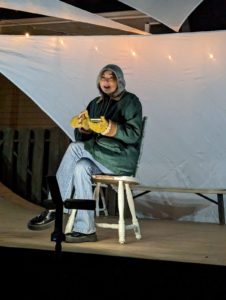 We also did some improv, which put Aly outside of her comfort zone. But just as I supported her, she supported something I enjoy doing and had just done on stage the previous night at Last Best Comedy.